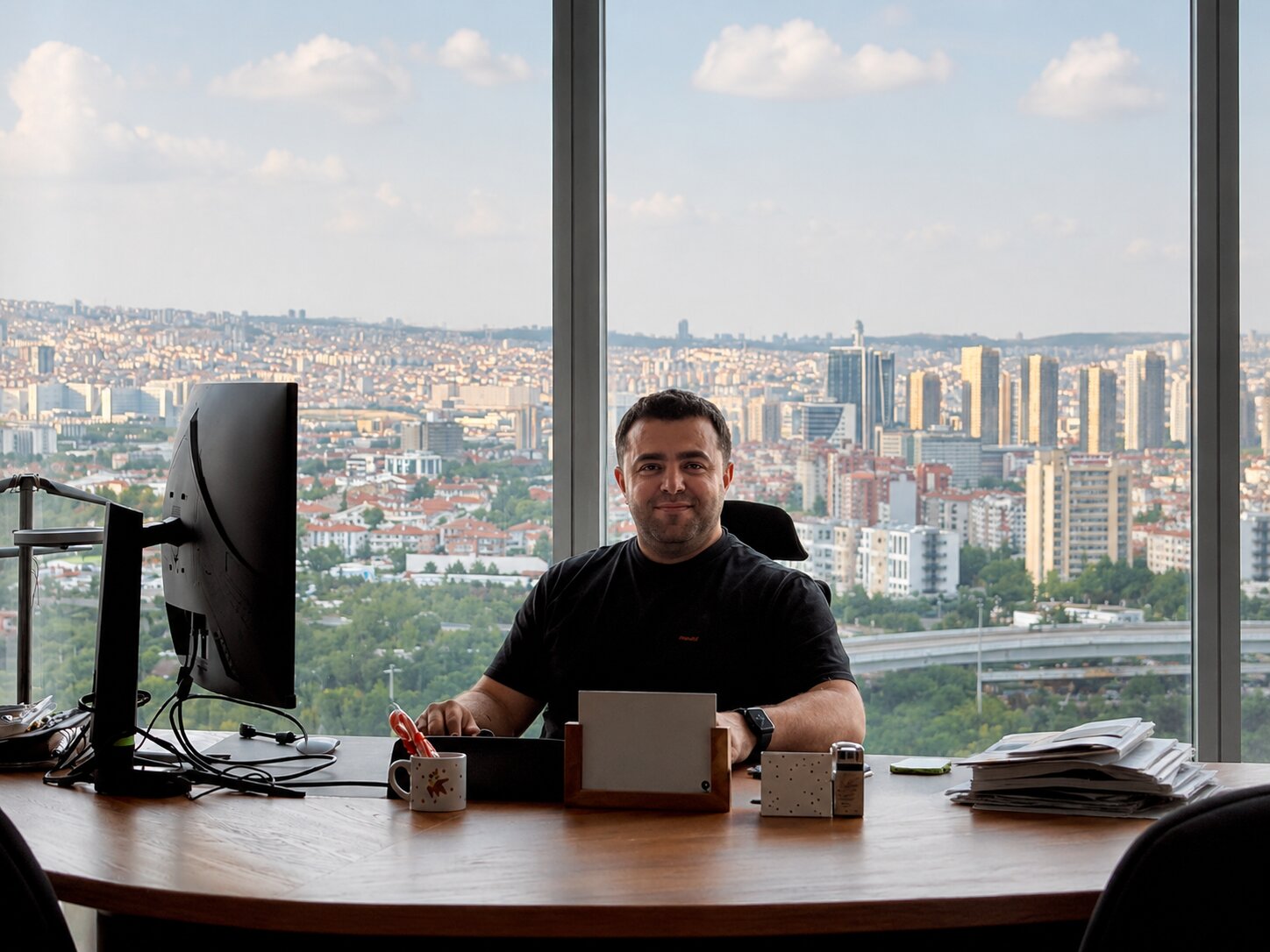
Hakan Baysal’s career sits at an unusual meeting point. He trained as a computer engineer and spent his early years on the defensive side of cybersecurity. He designed deception systems and honeypots, built dark web monitoring and data leakage platforms, and worked on crime analysis and single sign on systems used by public institutions. Today he is Chief Technology Officer at TRMiX Yazılım Hizmetleri A.Ş., where he applies that same security first discipline to one of Türkiye’s largest applied AI efforts: the AI layer behind the national EBA education ecosystem, which serves millions of students and teachers. For more than a decade his work has combined hands on engineering with architectural leadership. He holds a firm view that as AI moves into critical, high trust settings, the discipline that once protected networks now has to protect models, data and decisions. In this conversation he talks about how a security mindset shapes the way he designs AI systems, the problems he had to solve to make those systems reliable at scale, and where he thinks the field is going.
You have built your career where AI and cybersecurity meet. How would you describe your technical focus today?
My focus is on building AI systems that are capable and also trustworthy in places where mistakes carry real consequences. In practice that means designing retrieval augmented generation pipelines, vector embedding and semantic search systems, and LLM based classifiers. Then I treat every one of those parts the way a security engineer treats a live production network. I look at the data coming in and ask where it could be poisoned or where it could leak. I ask how someone might manipulate a model through its inputs, and how each output can be traced back to a source we can verify. My security background is not a separate chapter of my career. It is the lens I use when I look at AI. When you have spent years building deception systems and watching how attackers actually behave, you design AI platforms with very different assumptions about trust.
Let us go back to that foundation. What did your early cybersecurity work involve, and how did it shape your approach?
At CatchProbe Intelligence Technologies I led several products in cyber intelligence. Among them were Smart Deceptive, a deception platform, DarkMap for dark web monitoring, LeakMap for data leakage detection, and CrimeSuite for crime analysis, along with single sign on systems. Before that, at InterProbe, I developed the gateway and Linux engine parts of a honeypot system, which strengthened threat detection and network deception. Earlier, at Proda, I worked on the Sandbox project together with STM and contributed to defence sector projects under the Presidency of Defence Industries. I also served on the technical committee of HackIstanbul 2021, one of the largest cybersecurity competitions in the region. That kind of work teaches you a particular humility. In deception engineering you assume the system will be probed by someone smarter and more patient than you expected. So you design for observability, traceability and graceful failure rather than for the happy path. You learn that the dangerous problems are the quiet ones, the log that was never collected or the signal that looked perfectly normal. I brought all of that straight into the way I build AI today.
How does that security thinking change the way you build AI systems in practice?
The clearest example is something I call risk scoring at the prompt and content layer. In the EBA work my team ran an AI curriculum pipeline that handles automated topic extraction, learning outcome mapping and metadata generation. It also does prompt based risk scoring, and that part matters most. When you serve AI to a national audience that includes children, you cannot treat the model as a black box that simply answers. Every request and every piece of generated content has to be checked for risk before anyone trusts it, in the same spirit that a SIEM evaluates events. Beyond that, I designed the architecture so that data governance, compliance and isolation are treated as first class concerns rather than afterthoughts. We use federated vector databases, controlled embedding pipelines and strict boundaries between data domains across millions of content items. The security instinct of assume breach, validate everything and keep your evidence carries over almost directly from network defence to AI platform design.
You have argued in public that the hardest part of getting AI to give the right answer is not the model but the retrieval layer. Can you unpack that?
Yes. Much of the public conversation assumes that when AI gives a wrong answer, the model is to blame. In my experience the real bottleneck is usually the search and retrieval layer that feeds the model. If the system pulls the wrong context, even the best model will produce the wrong answer with full confidence. In a high trust setting that confidence is exactly what makes it dangerous. So a lot of my engineering effort goes into the retrieval side. That means high quality vector embeddings, semantic search tuned to the real domain rather than to generic text, and classifiers that decide what context is relevant and what is not. We built and deployed federated vector databases and embedding pipelines using tools such as Ollama and BGE M3 alongside custom LLM endpoints, all so that similarity search stays accurate and semantic tagging stays reliable. Getting that layer right is what separates a demo from a system you can put in front of millions of users.
Scaling an AI platform to national use is a serious engineering challenge in itself. How did you approach it?
When I joined as CTO, a big part of the task was modernising the EBA digital ecosystem into a modular, microservice based AI platform with better scalability, observability and data isolation. I guided the move from legacy systems toward cloud native, containerised and event driven architectures. We also built and maintained high availability Kubernetes clusters that run the NLP services, the data consumers and the real time inference workloads. None of that is glamorous, but it is where reliability is won or lost. I have done similar infrastructure work throughout my career. At Dista, for example, I led the migration of microservices from Google Compute Engine to Google Kubernetes Engine and strengthened the authentication and authorisation layers with Keycloak. The constant thread is simple. The AI is only as good as the engineering discipline underneath it.
Your path went from hands on engineer to leading cross functional teams and now a CTO role. How do you think about leadership?
I still think of myself as an engineer first. I am happiest when I am close to the problem. But for me leadership is about creating enough architectural coherence that talented people can move quickly without pulling in different directions. At TRMiX I lead cross functional teams across backend, frontend, mobile, DevOps and AI, and we work toward one platform whose architecture, product goals and AI strategy actually fit together. Earlier, at Dista, I led the ECHO CTI team and coordinated both the development and the infrastructure work. What I try to give a team is a short list of things we will not compromise on, such as traceability, data governance and observability, and then a lot of freedom inside those limits. My time on the HackIstanbul technical committee taught me something similar. You set a demanding bar and then you let strong people rise to it.
Beyond your day to day role, how do you stay engaged with the wider sector?
I run my own technology company, Karen Soft. Through it I advise public institutions and private companies on applied AI and cybersecurity, and I help them adopt these technologies safely instead of chasing the hype. Much of that is the translation work the field badly needs right now. You take the lessons from security and from large scale AI and you make them usable for organisations that do not have deep expertise in house. I also stay close to the engineering community. I share my work and side projects openly on GitHub, I enjoy embedded systems and hobby IoT projects in my own time, and I try to write and speak about what building AI is really like rather than the marketing version. My early research was a robotics and autonomous control project that won first prize in TÜBİTAK’s industry oriented undergraduate competition. That is where my habit of building things end to end began, and I have never lost it.
Where do you see the meeting point of AI and cybersecurity going over the next few years?
There are two directions here, and they are moving closer together. The first is that AI becomes a core tool of cyber defence. It can analyse huge volumes of telemetry and find the behavioural anomalies that static rules miss, which plays straight to the strengths of the systems I build. The second, and the more urgent one, is that AI itself becomes something we have to secure. Models, prompts, training data and retrieval layers are all attack surfaces now, and the industry is only starting to treat them that way. My belief is that the organisations who do well will treat AI as a system that is engineered and validated continuously, with the same care around configuration, data governance and traceability that mature security teams already apply. That is the standard I try to build to. It is also the contribution I most want to keep making, which is helping AI earn the trust that its growing responsibilities demand.
About Hakan Baysal
Hakan Baysal is Chief Technology Officer at TRMiX Yazılım Hizmetleri A.Ş. and the founder of the technology company Karen Soft. He holds a degree in Computer Engineering from Fırat University and has more than a decade of experience across cyber intelligence, deception systems, dark web monitoring, data leakage prevention and large scale applied AI. He has received several TÜBİTAK awards and served on the technical committee of HackIstanbul 2021.
Web: hakanbaysal.com LinkedIn: linkedin.com/in/hakanbaysal